I help established SMEs understand what needs to change when the way they currently work no longer matches the level they are trying to reach.
My background is not a straight-line consultancy career, and that is a significant part of its value.
I began work at 16, firstly in small local businesses, then across senior administrative, project, marketing and commercial roles. Over time, I moved through organisations of different sizes and shapes: SMEs, national organisations, large corporates, charities, public-sector-adjacent environments and specialist service businesses.
That gave me a practical education in how businesses really work.
Not just the strategy on paper, but the decisions, relationships, systems, habits, workarounds, risks and pressures that determine whether strategy becomes reality.
A career built around organisational credibility
In 2004, I moved into the buyer side of procurement, supporting the management of tendered service and capital contracts.
That experience sharpened my understanding of governance, risk, evidence and buyer confidence: what organisations need to prove, how commercial decisions are made, and why credibility depends on far more than good intentions or persuasive language.
In 2006, I founded UK Bid Writer, working with SMEs across sectors to help them find, understand and compete for more demanding opportunities.
For nearly two decades, that work gave me a rare view inside the machinery of growing businesses. A bid or framework submission often reveals the truth of an organisation very quickly: how clearly it understands its value, how well its systems hold together, how confidently it can evidence performance, and whether it is genuinely ready for the work it wants to win.
Over time, the question underneath the work became less about tenders and more about organisational readiness:
What does this business need to become to credibly win, deliver and sustain its next stage of work?
That question now sits at the heart of Redesigning Business.
Broader experience
Alongside my consultancy work, I have led and supported digital, operational and communications projects, including implementation work across a seven-branch national charity.
I have worked with businesses in construction, security, environmental services, professional services, facilities, technology and specialist contracting.
I have also run my own independent consultancy through changing economic conditions, shifting markets and the familiar pressures of small-business life: capacity, cashflow, positioning, delivery, reputation and reinvention.
That matters because I understand SMEs as living systems, not abstract case studies.
I know that change has to be commercially useful, operationally realistic and proportionate to the people who actually have to make it happen.
Why this work now
The commercial environment facing SMEs is becoming more complex.
Technology is changing what is possible, what is expected and what can quietly fall behind. AI in particular is often discussed as a tool problem, when for many businesses it is really a strategy, judgement, capability and organisational design problem.
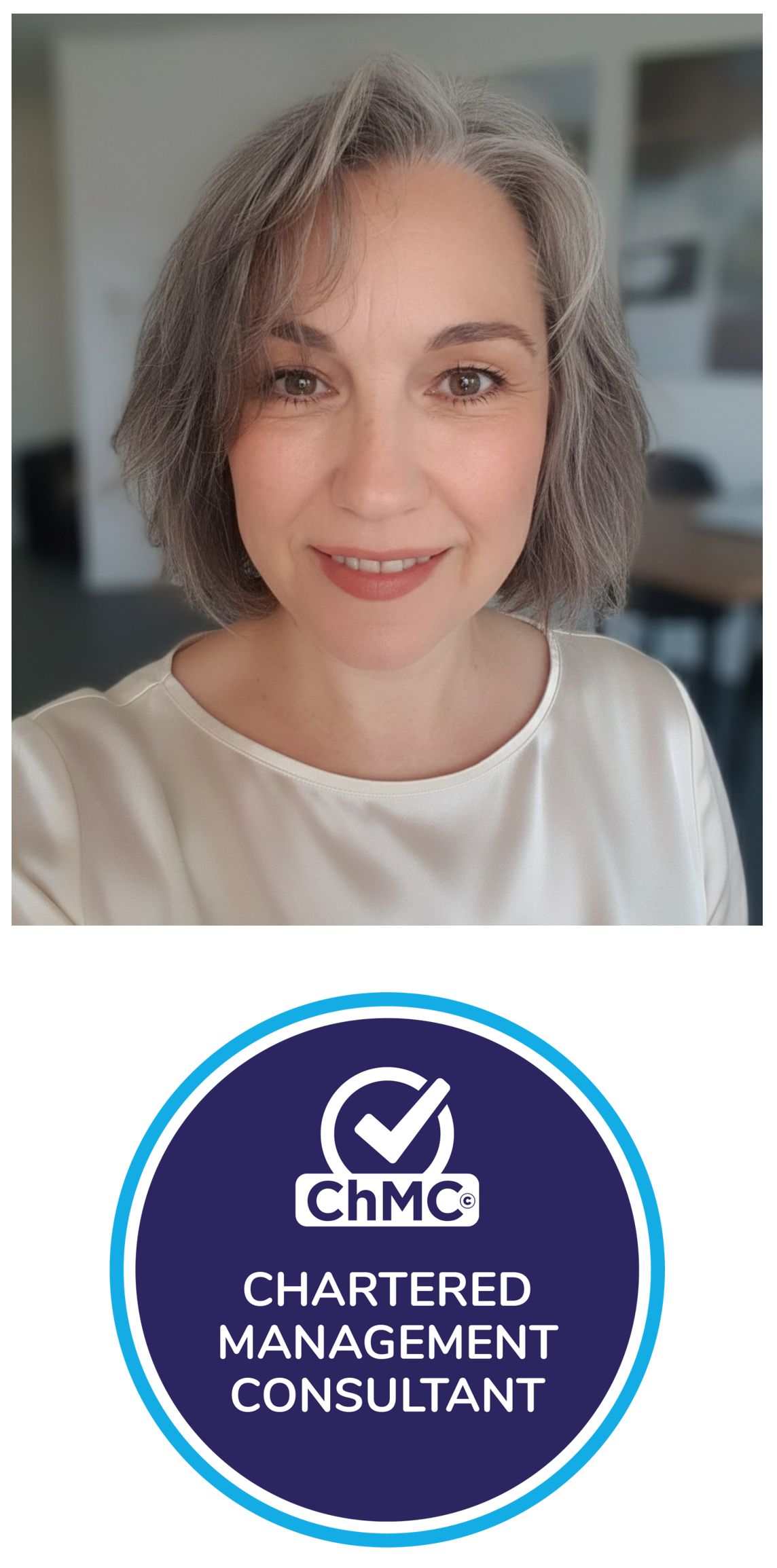
In 2025, I completed London Business School’s The Business of AI: Strategies for Leaders programme. I also achieved Chartered Management Consultant status, the highest award in the management consulting profession.
My work now brings together strategic clarity, operational realism, commercial judgement and intelligent use of AI and digital tools.
The aim is not change for its own sake.
It is to help capable businesses become more credible and resilient for the future they are trying to build.
How I think
I am interested in the pattern underneath the problem.
A business may arrive with a growth question, an AI question, a delivery problem, a bid-readiness concern, a positioning issue or a sense that things are becoming harder than they should be.
The key is understanding how those things connect.
What is structural?
What is cultural?
What is commercial?
What is a systems issue?
What is a leadership decision waiting to be made?
What is the business asking of itself that it is not yet designed to support?
That is where I do my best work.
A practical standard
Good consultancy should not make a business dependent on the consultant.
It should sharpen understanding, improve decisions, increase capability and leave the leadership team better able to see its own system.
That is the standard I work to.